



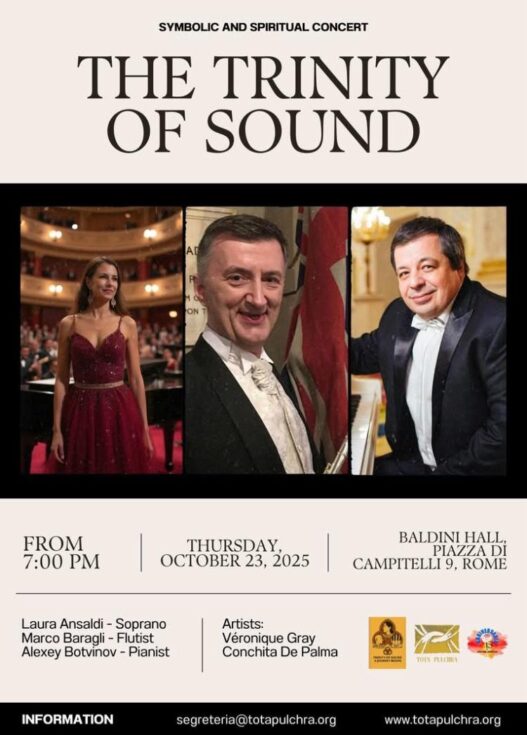
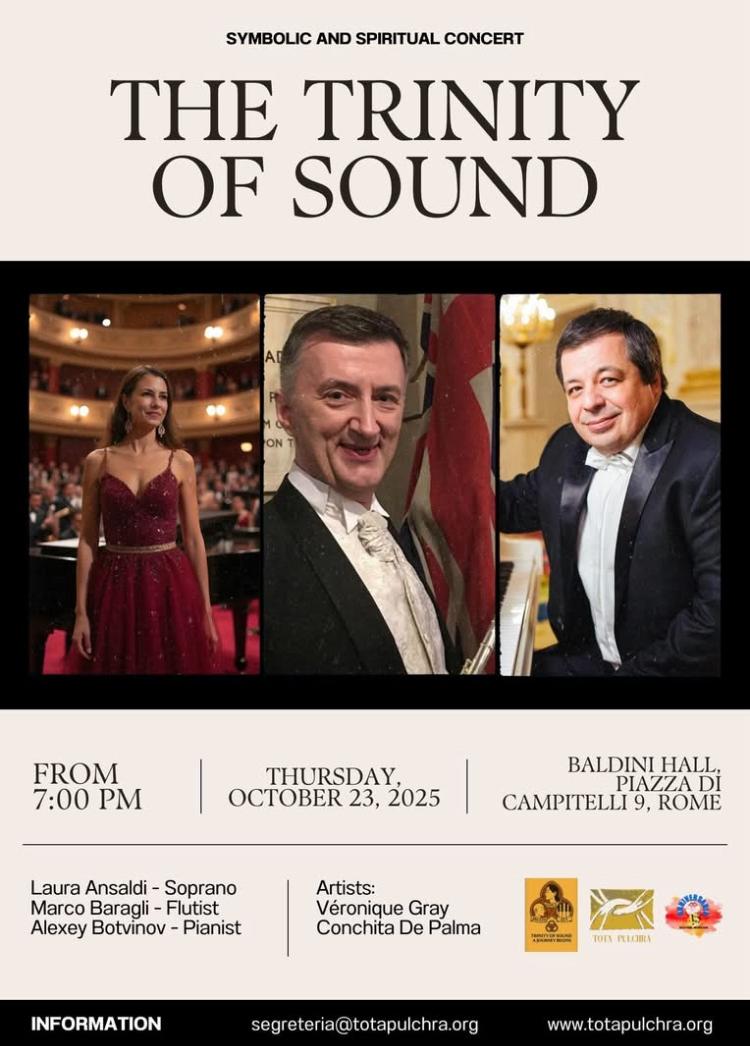
Symbolic and Spiritual Concert
Tuesday, October 23, 2025, 7:00 PM
Baldini Hall, Piazza di Campitelli 9, Rome
On the occasion of the international concert The Trinity of Sound, the participating artists discuss their approaches to music, visual arts, and performance, reflecting on the symbolic and spiritual significance of the event. The entire symbolic interpretation and conceptual framework of the project are curated by Marco Baragli. The Milan-based record label Kicco Music, of which Marco is a member, will record the performance live.
Artist Introductions
Marco Baragli – Flutist
Flautist and creator of The Trinity of Sound, Marco Baragli explores music as a spiritual experience. In the concert, he interprets the flute as a symbol of “Breath” and the Holy Spirit, creating a bridge between sound and consciousness. His symbolic reading guides the entire project structure.
Laura Ansaldi – Soprano
Internationally acclaimed soprano, Laura Ansaldi combines vocal technique with profound emotional depth. Her voice functions as a vehicle for spiritual communication, conveying emotions that transcend the written text. In the concert, she leads the audience through an intense and immersive inner experience.
Alexey Botvinov – Pianist
International pianist and performer, Alexey Botvinov considers the piano a means of transmitting intention and emotion. Each note interacts with other instruments, creating a rich musical texture. His global experience enhances the symbolic dimension of the concert.
Véronique Gray – Visual Artist
A visual artist who translates sound and atmosphere into forms and colors, Véronique Gray creates images as silent scores. Her paintings amplify musical emotions, merging art and auditory experience. At the concert, her works complete the dialogue between sight and sound.
Conchita De Palma – Painter
Painter and creative, Conchita De Palma uses musical rhythm and atmosphere to guide her artwork. She transforms music into sensory images that amplify the audience’s emotional experience. Her visual creations are an integral part of the concert’s symbolic dimension.
When working on a musical or visual project, which elements primarily guide your artistic choices?
Marco Baragli (flutist)
“For The Trinity of Sound, the flute is not merely an instrument: it is the ‘Breath’ that animates the concert. During performance, each musical phrase becomes an act of creation, a pulsation that conveys energy and movement. The flute embodies the vital heartbeat of the event, accompanying the audience’s inner transformation in a shared spiritual experience.”
Véronique Gray (visual artist)
“I am mainly guided by rhythm, atmosphere, and emotion. Music influences my choice of textures, colors, and materials — whether fabrics, plaster, bandages, or paint. Lyrics can inspire images or tactile elements, but above all it is the mood and energy of the piece that shape my artistic decisions. When I paint outdoors, natural light, the wind, and the surrounding environment also influence the work. I often listen to dynamic music — pop, soul, opera, or classical, such as Vivaldi or Andrea Bocelli — and sometimes specific words, like “sun” or “flowers,” trigger elements in the composition.”
Conchita De Palma (painter)
“During the project, the atmosphere and rhythm of the pieces serve as my pictorial guide. The flow of music and emotion inspires my works, transforming each visual mark into a sensory echo of the sounds the audience will experience during the concert.”
Do you believe that a visual work or musical element can “anticipate” or “prolong” the audience’s experience?
Marco Baragli (flutist)
“During the performance of Hildegard von Bingen’s piece, the flute becomes sacred breath: the audience does not merely listen, but breathes alongside the music. This generates a shared wave that travels through Baldini Hall, transforming the experience into a spiritual encounter.”
Véronique Gray (visual artist)
“Absolutely yes. A painting can set the emotional tone even before a note is heard, preparing the viewer for the music. During listening, colors, textures, and layers enrich the musical experience, creating a dialogue between sight and sound. In my painting of the angel, for example, gold leaves, fabrics, and scratching techniques build depth and movement; while in the horse painting I incorporated collage with musical notes and a key. These elements allow the viewer to perceive rhythm and emotion in the music, and even after the sound has faded, the visual elements continue to resonate, prolonging the experience.”
Conchita De Palma (painter)
“The visual work, in synergy with the concert, creates a unified experience of authenticity and spirituality. The images amplify and transform the music, making the performance more immersive and sensory.”
Have you ever perceived your work as a kind of visual/musical score?
Véronique Gray (visual artist)
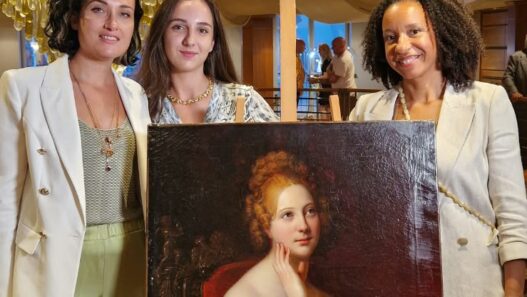
“Yes, very much so. There is rhythm and flow in every work — textures, shapes, and tones create movement and emotion. In Two Women, the bandages, Jakob Schlaepfer’s haute couture fabrics, and layered painting function like notes and pauses, each element contributing to the overall harmony. My compositions act as a silent score, where every gesture and material translates a feeling into visual rhythm, echoing the structure and heartbeat of music.”
Conchita De Palma (painter)
“Assigning colors and shapes to the musical notes of the concert was a surprising discovery. The visual score makes the rhythm and harmony of the music perceptible even to the eyes.”
Laura Ansaldi (soprano)
“The singing in this concert becomes a vibration of the soul. In pieces such as Verdi’s Pace mio Dio or Mahler’s Lied, the voice conveys emotions that surpass words, communicating spirituality and depth.”
How do you manage emotional communication with the audience during such a symbolic and spiritual concert?
Laura Ansaldi (soprano)
“My priority during The Trinity of Sound is to connect the audience with profound and varied emotions: from joy to tranquility, up to the divine light. Each listener experiences the concert uniquely, engaging with their own inner self through the music and the vibration of the voice.”
How do you interpret the “Key” as a medium that embodies musical intention, and how is this reflected in your performance?
Alexey Botvinov (pianist)
“For me, the piano, the “Key”, is an instrument of intention and emotion. Every note can open a door, be it to tenderness, power, mystery, or light. When I perform with others, I try to make the piano not just an accompaniment but a voice of its own, guiding the music’s soul and shaping the conversation between the other elements.”
How does your international experience enrich the execution of a concert that blends symbolic and spiritual elements?
Alexey Botvinov (pianist)
“Playing for audiences across the world has taught me that music speaks beyond language or culture. I’ve felt its power in Odessa, San Francisco, Tallin, Zurich, Sydney, Milan … everywhere it creates connection. My life’s journey helps me bring openness and depth to projects like The Trinity of Sound, where symbolism and spirituality are at the heart. It reminds me that art can unite us, even when we come from very different worlds.”
Event Details
Date: Thursday, October 23, 2025
Time: 7:00 PM
Venue: Baldini Hall, Piazza di Campeitelli 9, Rome
Artists:
Laura Ansaldi – Soprano
Marco Baragli – Flutist
Alexey Botvinov – Pianist
Véronique Gray- visual artist
Conchita De Palma- painter
Information:
segreteria@totapulchra.org – www.totapulchra.org
The evening will be recorded live by Kicco Music, Milan.