






Ascolta la versione audio di questo articolo (generata da IA).
Syria has become distant and difficult to understand; for too many years now, it has only made its presence felt in the news in the form of tragedy. But it has always remained dear to our hearts, because it is itself an incomparable melting pot of Mediterranean civilisations.
Syria has an impressive history: from its origins to the Hellenistic kingdoms, from the Roman era to Christianity, from Islam and Ottoman domination to the present day. It is a civilisation whose time span covers ‘ten thousand years’, it is often said, or even a million years since the Palaeolithic. The richness and complexity of this history form a universe that is both fabulous and dizzying, and so important for our understanding of the world, including today.
The great meeting of East and West under the Seleucids, heirs to Alexander the Great, is witnessed by the cities of Antioch, Latakia and Apamea, in memory respectively of the father, mother (Laodi-cea) and eastern wife (Afamia) of Seleucos I, as well as Dura Europos on the Euphrates.
Syria was Roman. In the 3rd century AD, Rome’s emperor was Philip the Arab (NB: He re-established peace on the Danube and is sometimes considered the first Christian emperor) and, at the same time, the kingdom of Palmyra developed in the face of the Sassanids, who had succeeded the Parthians; the apogee of Palmyra was the reign of Zenobia – at once resistant, courageous and also excessively ambitious for having proclaimed herself empress – who eventually capitulated to Aurelian in 272, but the cultural and economic influence of the city never waned.
Christianity preceded Islam and Ottoman domination. There are many Christian churches dating from the5th century on what is known as the ‘limestone plateau’ or ‘dead cities’ to the south of Aleppo. At the end of the fourth century, Christianity became established and Syria became part of Byzantium. From the outset, Islam flourished there, and the Umayyad mosque, completed in 715, became a model even in Muslim Spain (see ‘Andalusia from Damascus to Cordoba’); with the Abbasids, Baghdad became a new centre; from the 16th century, Syria came under Ottoman rule, leaving Damascus with the Sinan-Pasha mosque and the Azem Palace, which for a time housed the French Institute.
Apamea, on the edge of a plateau overlooking the Orontes valley, is a magical place. For several centuries, around the beginning of the first millennium, it was a military town which, at its peak in the 2nd century AD, was home to royal stud farms, cavalry horses and 500 elephants, a kind of deterrent force before its time. Conquered by Pompey in 64 BC, who made it a Roman province, it was home for a time to Antony and Cleopatra. The queen found herself pregnant. But if there is romance in history, which is sometimes no more than a myth, history as a whole is devoid of it. It is often tragic.
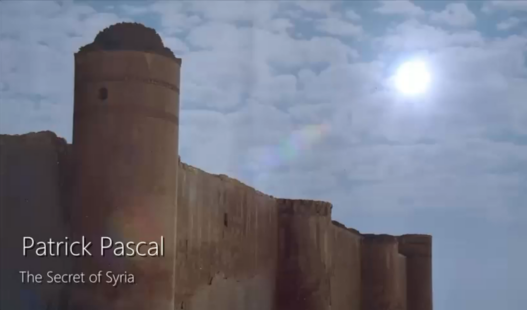
(Video: Maia Sylba, Musetouch)