




Ascolta la versione audio di questo articolo (generata da IA).
Dove sta andando la guerra? Da nessuna parte, si dissolve in una sorta di nulla, e il silenzio che segue è la musica più bella di tutte.
Armonia, idealo umano
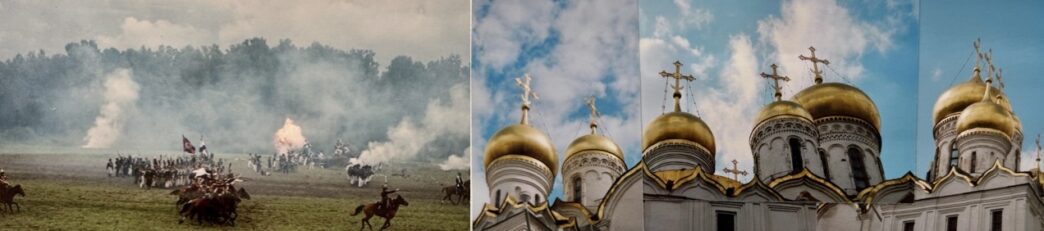
Il mondo è spesso un frastuono, un rumore, una cacofonia e il rullo dei tamburi di guerra, come i cannoni di Austerlitz, che purtroppo spesso completano questo mondo sonoro quando non lo dominano. La musica può essere sia fonte di ispirazione sia semplicemente l’organizzazione del rumore in un insieme più coerente che tende all’armonia. L’armonia è l’ideale umano, non il mero ordine; non possiamo accontentarci di un “l’ordine regna a Varsavia”. Possiamo cercare di proiettare la musica che abbiamo nella nostra mente sulle realtà del mondo; ciò significa che abbiamo raggiunto una certa comprensione dei fenomeni che ci circondano o che vogliamo addirittura provare a padroneggiarli. L’*Ouverture 1812* di Čajkovskij si conclude con un finale parossistico in cui i fragori della Battaglia della Moscova si fondono con i rintocchi delle campane delle chiese del Cremlino, portando infine un certo senso di calma. Perché dove sta andando la guerra? Da nessuna parte, si dissolve in una sorta di nulla, e il silenzio che segue è la musica più bella di tutte.
Un mondo barocco
Viviamo in un mondo che si potrebbe definire barocco, un mondo di violenza ma anche di piacere sfrenato e di libertà senza limiti. L’essenza del barocco, dal XVI al XVIII secolo, è fondamentalmente un contrasto tra luce e ombra. Nella musica, la leggerezza si alternava alla sontuosità dei brani cupi. L’approccio è per metà solenne, per metà voluttuoso, nella tradizione delle grandi figure del Rinascimento italiano del Quattrocento. È vero che spesso coltiviamo l’amore per l’ombra, come Serse nel famoso Largo *Ombra mai fu* dell’opera di Händel. Ma è tutto vano, perché la luce può anche imporsi su di noi, nostro malgrado. Infine, il Barocco era decisamente ottimista. La luce trionfa, ad esempio, sulla Regina della Notte, l’incarnazione del male (“un avvoltoio con la voce di un usignolo”), nel *Flauto magico* di Mozart, un’opera massonica per eccellenza che riflette una scristianizzazione in anticipo sui tempi, ma intrisa di spiritualità grazie al culto di Iside e Osiride ereditato dall’antichità egizia. Il Sommo Sacerdote Sarastro conclude l’opera con l’ovvia saggezza secondo cui “i raggi del sole scacciano la notte” (die Strahlen der Sonne vertreiben die Nacht).
La voce potente della natura
La musica del mondo è, in definitiva e forse soprattutto, la voce potente della natura; essa non può essere una cacofonia e possiede una sua coerenza, frutto dello scorrere vertiginoso del tempo necessario all’evoluzione. Se si dovesse scegliere un musicista per illustrare le epopee dei navigatori a sud dei paralleli 40° e 50°, questo sarebbe innanzitutto Beethoven. La *Sesta Sinfonia*, “quel paesaggio sorprendente composto da Poussin e disegnato da Michelangelo”, secondo Hector Berlioz, riproduce lo scatenarsi degli elementi e rivela mattine serafiche; ci abbandoniamo alla natura per superare il destino. E la Nona Sinfonia, nel suo compimento finale, è un inno al mondo che diventa un inno alla gioia.
Cacophony and harmony in the world
Harmony, human ideal
The world is often clamour, noise, cacophony, and drumbeats of war, like the cannons of Austerlitz, unfortunately often complete this world of sound when they don’t dominate it. Music can be both inspiration and simply the organisation of noise into a more coherent whole tending towards harmony. Harmony is the human ideal, not mere order; we cannot be satisfied with ‘order reigns in Warsaw’. We can try to project the music we have in our heads onto the realities of the world; this means that we have reached a certain understanding of the phenomena that surround us or that we even want to try to master them. Tchaikovsky’s *1812 Overture* ends with a paroxysmal finale in which the rumblings of the Battle of the Moskva blend with the chimes of the Kremlin churches, ultimately bringing a certain sense of calm. For where is the war going? Nowhere, it dissolves into a kind of nothingness, and the silence that follows is the most beautiful music of all.
A Baroque world
We live in a world that could be described as Baroque, a world of violence but also of uncontrolled pleasure and boundless freedom. The essence of Baroque from the sixteenth to the eighteenth centuries is fundamentally an opposition between light and shade. Lightness alternated with the sumptuousness of dark pieces when it came to music. The approach is half grave, half voluptuous, in the tradition of the great figures of the Italian Renaissance of the Quattrocento. It is true that we often cultivate a love of the shadow, like Xerxes in the famous Largo *Ombra mai fu* (the shadow never was) from Handel’s opera. But it’s all in vain, because the light can also impose itself on us, in spite of ourselves. Finally, Baroque was resolutely optimistic. Light triumphs, for example over the Queen of the Night, the embodiment of evil (‘a vulture with the voice of a nightingale’), in Mozart’s *The Magic Flute* , a Masonic opera par excellence reflecting a de-Christianisation before its time, but imbued with spirituality with the cult of Isis and Osiris inherited from Egyptian antiquity. The High Priest Sarastro concludes the opera with the obvious wisdom that ‘the rays of the sun chase away the night’ (die Strahlen der Sonne vertreiben die Nacht).
The powerful voice of nature
The music of the world is finally, and perhaps above all, the powerful voice of nature; this cannot be cacophony and it has its coherence, resulting from the dizzying passage of time necessary for evolution. If one musician were to be chosen to illustrate the epics of the navigators south of the 40th and 50th parallels, it would first and foremost be Beethoven. The *6th Symphony*, ‘that astonishing landscape composed by Poussin and drawn by Michelangelo’, according to Hector Berlioz – reproduces the unleashing of the elements and reveals seraphic mornings; we abandon ourselves to nature to overcome destiny. And the 9th Symphony, in its final fulfilment, is a hymn to the world that becomes a hymn to joy.