



Ascolta la versione audio di questo articolo (generata da IA).
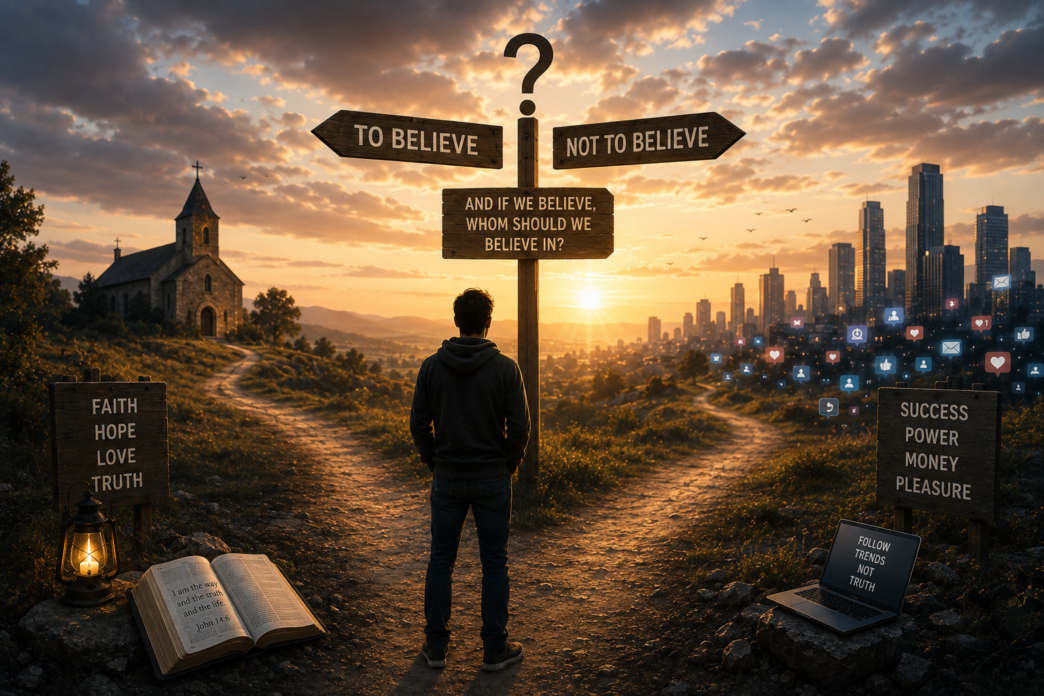
Since the beginning of history, human beings have searched for answers to the deepest questions of existence: Where do we come from? Why are we here? What happens after death? What is the true meaning of life? These questions have crossed every age and every culture, and they continue to challenge people today despite scientific and technological progress. To believe or not to believe is not simply a religious choice; it is a decision that shapes the way we see the world, face suffering, cultivate hope, and build our future. And if we choose to believe, another question naturally arises: in whom should we place our trust? In God, in humanity, in science, in wealth, or in ourselves? Every answer leads to a different understanding of life and happiness.
The Bible presents faith as a relationship of trust before it is a set of rules. Jesus says, “I am the way and the truth and the life” (John 14:6), reminding us that faith is not merely believing in an idea but encountering a living person. The prophet Jeremiah also declares, “Blessed is the one who trusts in the Lord, whose confidence is in Him” (Jeremiah 17:7). These words do not ask us to reject reason; instead, they encourage us to recognize that some realities go beyond what we can see or prove. Faith does not eliminate doubt; rather, it teaches us to live with it and transform it into a path of discovery.
Theological reflection has explored this theme for centuries. Saint Augustine wrote in his Confessions: “You have made us for Yourself, and our hearts are restless until they rest in You.” His words express the deep longing for the infinite that lives in every human heart. Saint Thomas Aquinas taught that faith and reason are not enemies but companions in the search for truth. More recently, Pope Benedict XVI stated that “faith broadens the horizons of reason,” inviting us to understand that science and faith do not have to oppose one another. Genuine faith is never afraid of questions because it knows that every sincere search for truth can lead us closer to God.
Philosophy has also offered different perspectives on belief. Blaise Pascal argued that “the heart has its reasons which reason knows nothing of,” suggesting that not everything meaningful can be explained through logic alone. Søren Kierkegaard described faith as a “leap,” a courageous and personal choice that requires freedom and commitment. Friedrich Nietzsche, with his famous declaration that “God is dead,” challenged society to reflect on the loss of absolute values. Even today, his words remind believers that faith should never become a mere habit but must remain a living and conscious choice.
Literature has often explored humanity’s search for God. In The Betrothed, Alessandro Manzoni shows how Divine Providence accompanies human life even in moments of suffering. The hardships faced by Renzo and Lucia are not denied but gain meaning through their trust in God. Dante Alighieri, in The Divine Comedy, transforms his journey through Hell, Purgatory, and Heaven into a symbol of the human search for truth and salvation. Fyodor Dostoevsky also examined the relationship between faith, freedom, and responsibility, showing how difficult it is for human beings to live without a moral foundation capable of giving meaning to good and evil.
Poetry often expresses profound truths in just a few words. The Italian poet and priest David Maria Turoldo wrote, “To believe is to dare the impossible,” reminding us that faith does not remove life’s difficulties but gives us the strength to face them. Likewise, Saint Francis of Assisi, in his Canticle of the Creatures, praised God through the beauty of nature, teaching us that creation itself can become a source of gratitude and hope. Faith, therefore, does not distance us from reality; instead, it enables us to see it with new eyes, discovering beauty and meaning even in difficult circumstances.
Modern society presents a unique challenge. On one hand, more people identify as non-believers or indifferent to religion. On the other hand, many continue searching for spirituality in different forms. Some place their trust in technology, economic success, social media, or personal achievement. In a world that moves at an increasingly rapid pace, faith is sometimes reduced to a private feeling or an old tradition. Yet every person, even someone who claims not to believe in God, believes in something: justice, love, science, freedom, progress, or human dignity. The real question, therefore, is not whether we believe, but what we choose as the foundation of our lives.
Belief also carries responsibility. It is not enough to say that we believe if our actions contradict our words. As the Letter of James reminds us, “Faith without works is dead” (James 2:26). Authentic faith reveals itself through compassion, forgiveness, solidarity, respect for others, and care for those who are most vulnerable. True belief should never divide people; instead, it should inspire them to recognize the dignity and value of every human being.
So, should we believe or not? And if we do, in whom should we believe? There is no single answer that fits everyone. Each person must seek the truth with honesty, courage, and openness, without fearing doubts or difficult questions. Yet history, philosophy, literature, and theology all suggest that human beings need something greater than themselves to give meaning to life and strength in times of difficulty. As Antoine de Saint-Exupéry wrote in The Little Prince, “What is essential is invisible to the eye.” Perhaps faith belongs to that invisible reality that cannot be measured by science but can be discovered through love, hope, and the sincere search for truth. Ultimately, to believe means having the courage to open our hearts to something greater than ourselves, trusting that the search for meaning is one of the greatest journeys any human being can undertake.
Esposito Santolo Simone