



La leggerezza non è più quella di una volta

Può sembrare un po’ frivolo riflettere su questioni geopolitiche in un ambiente come le spiagge dei Caraibi, ad esempio a Cancún. Eppure, non esiste un luogo eternamente predestinato al relax e sempre immune dal clamore del mondo.
Il 2 agosto 1990 mi trovavo a Las Vegas, dove stavo concludendo un grande tour dell’Ovest americano, quando il mondo venne a sapere che Saddam Hussein aveva invaso il Kuwait. Chiamai il mio ambasciatore Pierre-Louis Blanc a New York, che in quel mese di agosto, in virtù del principio della presidenza mensile a rotazione, presiedeva per la Francia il Consiglio di sicurezza delle Nazioni Unite. Sembrava nervoso, cosa molto insolita per lui, di fronte a un evento che avrebbe avuto conseguenze considerevoli. Era decisamente ora di dimenticare le vacanze estive e tornare al lavoro. Infatti, il carico di lavoro continuò giorno e notte per mesi, con riunioni del Consiglio, anche nei fine settimana, fino alla sconfitta militare dell’Iraq.
La risoluzione 678 del Consiglio di sicurezza, adottata il 29 novembre 1990, autorizzava l’uso di «tutti i mezzi necessari» per imporre il ritiro dell’Iraq dal Kuwait; il termine era fissato al 15 gennaio 1991. Nonostante gli sforzi diplomatici (cfr. la dichiarazione del presidente Mitterrand all’Assemblea generale delle Nazioni Unite nel novembre 1990: «Se Saddam Hussein dimostrerà la sua intenzione di ritirarsi dal Kuwait, allora tutto sarà possibile»), l’intransigenza dell’Iraq appariva totale ed era chiaro che la guerra era imminente. Durante la settimana che precedette l’inizio delle ostilità (NB: i primi attacchi su Baghdad ebbero luogo il 16 gennaio), l’ambasciatore Blanc, che non si era mai fatto illusioni, sorprendentemente incoraggiò il suo staff a prendersi qualche giorno di ferie. Io feci un viaggio a Cancún e attraverso il meraviglioso Yucatan. Era possibile dimenticare per un po’ i tamburi di guerra che rullavano e le cui conseguenze a lungo termine si fanno sentire ancora oggi? Ma non è sempre così?
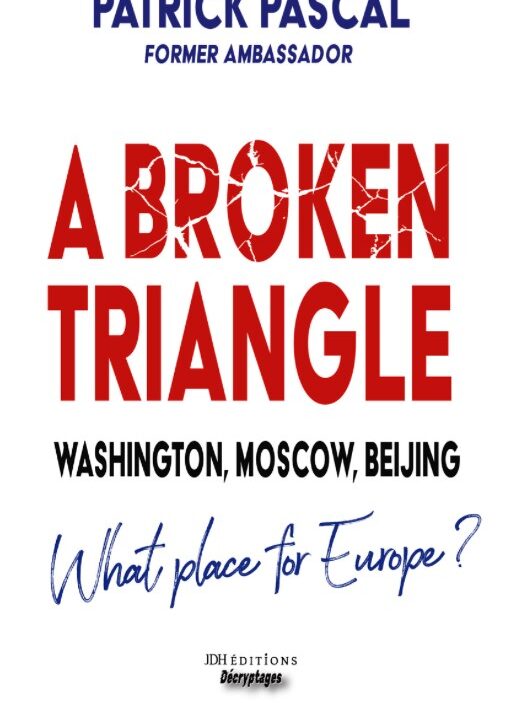
🔺A Broken Triangle 🔺:
(…) In Damascus, time was not the same. The 10,000 years of history had learnt to bend to other rhythms, other demands and hierarchies of priorities. Just as in the shade of the high walls of the Damascene houses in the old town, cradled by the spray of water from the central basin of the inner courtyard, people talked at nightfall for all eternity. The essence was there, in this concrete exchange, seemingly innocuous, but ultimately serious (…)
In Beirut, the western quarters, the corniche, the lighthouse, the military baths, places known from history, all these mythical places were also the scene of recent tragedies, those of the civil war. All the Mediterranean was there in a nutshell: a place of opulent life that the elements alone offered, but a tragic destiny (…); Beirut was a kind of Sisyphean rock of the good life, ambitions and pleasure, a miracle of permanent rebirth. The comfort of the corniche, the volumes, the rich and voluptuous decoration of the homes, brought to life a kind of waking Orientalism, reminding us of our dreams (…)
Il desiderio dell’Oriente

L’Asia centrale è un mondo a sé stante (NB: circa 4 milioni di km²), allo stesso tempo isolato dal resto del mondo e al centro di esso, tra le lotte di potere globali. Nel XIX secolo era al centro della rivalità tra l’impero russo e quello britannico. Questo periodo è noto come il “Grande Gioco”: il primo, con i suoi possedimenti coloniali in India, cercava di proteggere i propri interessi nell’Asia meridionale; il secondo perseguiva la sua naturale espansione verso est, in questo caso verso l’Asia centrale, sia per garantire i propri confini che per espandere l’impero. L’indipendenza delle repubbliche dell’Asia centrale alla fine dell’Unione Sovietica ha cambiato la situazione; il declino della Russia era evidente, ma Mosca ha ancora molti strumenti di influenza nella regione. La Cina esercita un’influenza economica e sta emergendo in modo ancora più evidente con il suo progetto delle Nuove Vie della Seta. Non vanno trascurati nemmeno altri attori, come la Turchia, l’Iran e persino l’India e la Corea del Sud.
Quando si viaggia dall’Occidente, attraversare il Mar Caspio è un’esperienza indimenticabile. Si tratta di una vera e propria frontiera geografica, climatica e culturale. Si entra quindi in un mondo minerale fatto di steppe e deserti. L’aria è incredibilmente pura, l’escursione termica è enorme (-40 °C ad Astana, in Kazakistan, in inverno e circa +50 °C in Turkmenistan in estate). Il mix di popoli e civiltà, in questo mondo di Alessandro Magno, ha dato vita a tipi fisici davvero unici.
🔺A Broken Triangle🔺:
‘The Great Game is likely to take on new forms. Will Central Asia be able to free itself from its powerful neighbours, commensurate with its immense potential and its location at the heart of the new Silk Roads? Or will it have to resign itself to being no more than a hinge between several worlds, or confine itself to playing the role of cordon sanitaire between a new East and the powers of Europe and the West ? (…)
Russia has maintained its positions in the region in a number of ways, whether through modes of governance often inherited from Soviet practices, economic networks, dependence of the states concerned on remittances from migrant workers, cultural soft power through the language and expatriate Russian communities or border security and some military presence (…)
In 2013 President Xi Jinping announced this Promethean project, known as the ‘One Road One Belt’ or ‘Belt Road Initiative’ (BRI). The ambition was to increase China’s trade with a large part of Central Asia and Europe by land, and with South Asia and Africa by sea. This would involve a third of the world’s GNP by 2049, which would coincide with the 100th anniversary of the People’s Republic of China (…) Europe remains a relatively marginal political player (…)
Guerra e Pace, Oriente e Occidente

Germaine de Staël scriveva in Dix Années d’Exil (Dieci anni di esilio) a proposito dei russi: «Cortigiani a Pietroburgo, diventano tartari nell’esercito». Ricordiamo anche che Guerra e pace di Tolstoj inizia nei salotti di Anna Pavlovna, dove si parla francese e si discutono argomenti frivoli insieme a Napoleone, alla guerra e al continente europeo.
In ogni caso, in Russia c’è sempre un altro paese oltre la realtà che vediamo; la visione che abbiamo da questa terra – e oggi soprattutto da Mosca – ha sempre una dimensione strategica ed è su scala globale. Lo sguardo non è rivolto esclusivamente all’Europa, ma si estende molto più a sud, verso un Oriente che esiste già all’interno della Russia, e fino alle coste del Pacifico. È qui che risiede il vero potere della Russia, in questa capacità mentale di coprire vaste terre e concepire progetti illimitati; questa disposizione è anche una debolezza, perché la visione imperiale distrae dalle proprie ricchezze umane, culturali e fisiche, che potrebbero essere maggiormente sviluppate.
Il principe Andrej Bolkonskij di Tolstoj antepone il dovere militare alla tenera ed emotiva Natasha Rostova.
🔺A Broken Triangle🔺:
(…) The Eurasian temptation is in fact a question of identity, which is not unique to Russia (…) Russia is a bicontinental, multi-ethnic, multi-religious and multi-cultural empire, and its Eurasism appears more as a protest against the West than an attachment to Asia (NB: this marks a difference with the Russian Slavophiles of the 19th and early 20th centuries). It should be remembered, in a country where history is part of the permanent collective memory, that the Mongol invasions of 1214 to 1552 – the most dangerous in the history of the Russian nation – came from the East and that the history of Russia, once its territorial expansion was complete, was always turned towards the West (…)
Even more than Slavophiles, Eurasians condemn Europe and its civilisation. The Eurasian debate reappeared in the early 1990s; the communist Zyuganov supported an alliance with China; the nationalist politician Zhirinovsky drew on the geopolitics of Haushofer and McKinder, emphasising the ‘Heartland’, and feared China as much as the United States; The philosopher Dugin was firmly in the anti-Chinese camp; Eurasians in general emphasised the specificity of Russian civilisation, but other thinkers stressed that post-Soviet Russia was and should be oriented towards Europe (…)
Primakov first conceived of a Moscow-New Delhi-Beijing triangle, which was naturally integrated into his strategic thinking. This project, which was conceptualised in what came to be known as the ‘Primakov Doctrine’ in 1998, prefigured the BRICS. But this triangle could also be described as a ‘trio of asymmetries’. China’sBelt and Road Initiative is likely to weaken Russian influence in the region (…)
In contatto con grandi placche telluriche

La regione napoletana è nota per la sua attività sismica. La geologia locale è un microcosmo della complessità del mondo e delle sue attuali fratture. Le placche tettoniche africana, eurasiatica e persino anatolica si incontrano nel Mediterraneo. Il Vesuvio è l’espressione di questa titanica lotta sotterranea. È allo stesso tempo un guardiano e una minaccia permanente. Ercolano e Pompei furono sepolte dalla cenere nel 79 d.C. L’ultima eruzione risale al 1944. A Napoli, rifugio degli dei fino all’avvento del mondo del calcio, e grazie alla vittoria di un nuovo Calcio nel 2024/2025, la terra trema ancora allo stadio intitolato a Diego Armando Maradona.
L’esplosione è quella della gioventù, dei suoi sogni e delle sue aspirazioni. Sal Ianniello, da parte sua, ha già deciso di conquistare da Napoli Roma e il mondo. A capo della sua società ISM (Impact Solution Marketing), esplora con abilità il mondo dell’innovazione digitale, che si tratti di definire una strategia, produrre contenuti video o audio, utilizzare i social media o, naturalmente, l’intelligenza artificiale (AI) di oggi.
🔺A Broken Triangle🔺:
(…) Compared with traditional diplomacy, which was based on political relations between states, economic diplomacy – which could also be said to have always existed in various forms – is nonetheless an innovation whose development has roughly coincided with globalisation. In a world where competition between economies and large companies is exacerbated, governments are now committed to supporting the latter, particularly in markets where economies are managed and where access to decision-makers is at the highest level. This does not mean, however, that small and medium-sized enterprises (SMEs) are being neglected when they boldly enter foreign markets, given their size and resources. Strategic sectors, which naturally include the weapons industry, but also transport, energy and space sectors, are at the heart of economic diplomacy, whatever the structure of the companies, whether the State is the majority shareholder or the companies are dependent on private shareholding (…)
Il prezzo dell’abbandono codardo

Il presidente americano può anche vantarsi delle “sue” guerre, in particolare della Seconda guerra mondiale, deridendo il ruolo limitato svolto da alcuni dei suoi alleati e ignorando completamente gli immensi sacrifici subiti da tutti i popoli dell’URSS, ma è stato lui a negoziare un accordo unilaterale con i talebani e a decidere il ritiro degli Stati Uniti dall’Afghanistan previsto per maggio 2021. Non essendo stato rieletto, è stato il suo successore democratico a fissare la data dell’operazione all’11 settembre 2021. Questo calendario è stato accelerato dal crollo del potere a Kabul, che ha permesso ai talebani di conquistare la capitale il 15 agosto; il caos che ne è seguito è stato di portata paragonabile alla caduta di Saigon nell’aprile 1975.
L’allora ministro degli Esteri francese dichiarò all’ONU: « che c’era chi se ne andava e chi restava, e che ci saremmo presi cura di entrambi ». Ma in entrambi i casi si è trattato di una tragedia, e cosa resta di questi nobili impegni? L’Afghanistan, spesso definito il « cimitero degli imperi », non è forse diventato il « cimitero degli innocenti »?
L’Afghanistan può essere un caso esemplare. Riunisce molte delle principali questioni internazionali contemporanee: crisi regionali in una zona nucleare, legittimità degli interventi negli Stati falliti, tragedie umanitarie, terrorismo, ricomposizione del mondo, ridefinizione delle organizzazioni e delle alleanze politiche, grandi progetti economici del XXI secolo.
Da questo punto di vista, la crisi afghana non può lasciare indifferenti, ma impone una riflessione rinnovata sulla politica estera. In tutti i casi – e questo vale anche per altri teatri operativi – non dimentichiamo il prezzo dell’abbandono e, soprattutto, della codardia.
🔺A Broken Triangle🔺:
(…) Afghanistan is in the eye of a nuclear storm. In addition to India and Pakistan, which carried out their first experiments in 1998, Russia and China, respectively the old and perhaps the new guardian power, are not far from this theatre. Iran, with its large Shiite Hazara community, its rejection of a competing religious model, the large migratory flows it has experienced as a result of the war and its status as a nuclear ‘threshold’ country, cannot be insensitive to what is happening in and around its neighbour.
Can Europe and even the United States, which withdrew at the end of a twenty-year war, lose interest in the medium and long term in this area, which is destined to be at the heart of major economic projects such as the new Silk Roads ? Will we remain passive on this new front line, as in the ‘Tartar Desert’, where waiting undermines the defenders and does not prepare them to meet the challenges? Will we simply say to ourselves, thinking of all the civilian and military victims on all sides over the past decades: was it all for this ? (…)