




Ascolta la versione audio di questo articolo (generata da IA).
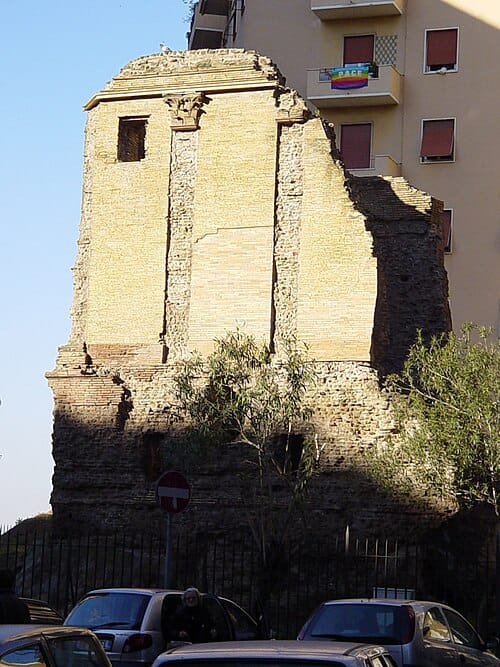
Today, modern Rome surrounds it. Streets run beside it, apartment buildings rise around it, and the noise of daily life passes close by. Yet the ancient mass of volcanic tufa appears strangely detached, almost like a fragment that does not belong to the city that grew around it.
Rome has always absorbed everything: pagan temples became churches, imperial ruins became foundations, forgotten monuments became part of new neighborhoods. But this structure has preserved a different fate. It remains suspended between worlds — neither fully ruin nor fully monument, neither forgotten nor understood.
Until the beginning of the twentieth century, the Devil’s Chair stood isolated in open countryside, far from the crowded heart of Rome. The area around the ancient Via Nomentana was then a landscape of fields, vineyards, and scattered ruins, where night arrived quickly and the silence made every stone seem alive.
It stood outside the old boundaries of papal Rome, and even today it carries the symbolic feeling of a place on the edge — a threshold between the inhabited city and the unknown.
Yet beneath the legends lies a very real Roman story.
The monument was originally the mausoleum of Elius Callistus, a wealthy freedman of the imperial age, probably dating to the 2nd century AD. It was not a place of mystery, but a respectable funerary monument built according to Roman architectural traditions: a decorated façade, multiple levels, and an underground burial chamber.
It represented something deeply Roman: memory made into stone.
But time is an unforgiving sculptor.
Centuries of abandonment, weather, and human intervention destroyed much of the original structure. The elegant façade disappeared, the architectural lines collapsed, and the monument lost its original identity.
What remained was something far more ambiguous: a massive stone shape, hollowed and transformed, resembling a gigantic seat facing the city.
A tomb had become a throne.
And when a monument loses its name, imagination gives it another.
When the Night Spoke
In medieval and early modern Rome, ruins were not silent. They were inhabited by stories, fears, and memories inherited from a world where ancient stones were often considered dangerous.
The Devil’s Chair stood alone in a landscape of shadows, and around it a new identity slowly formed.
People began to say that when the sun disappeared, the atmosphere around the stone changed. The air became colder. The darkness seemed heavier. Shadows did not merely cover the ground — they appeared to move against it.
Some legends described a dark presence sitting upon the stone, watching the city below. A gigantic figure with eyes like burning fire, motionless and patient, facing Rome as if guarding it or waiting for something.
Thus the legend of the Devil’s Throne was born.
It was said that at midnight the Devil himself occupied the seat.
But he did not behave like a simple demon of medieval imagination.
He did not shout.
He did not threaten.
He listened.
According to popular belief, those who came seeking forbidden knowledge, secret favors, or impossible desires could receive what they asked for — but always at a terrible price.
The Devil did not take gold.
He took something far more valuable.
The stories told of strange noises emerging from the ruins, footsteps with no visible owner, whispers carried by the wind, and a coldness rising from the earth itself, as if the ancient tomb still remembered the dead buried beneath it.
For centuries, the place became associated with occult traditions. Legends claimed that witches, fortune tellers, and practitioners of forbidden arts gathered there during the night, transforming an ancient Roman burial monument into a supposed gateway to hidden forces.
Whether these gatherings truly happened or were later inventions is difficult to prove.
But Rome has always lived through this mixture of fact and imagination.
Archaeology Defeats the Devil — But Not the Legend
During the nineteenth century, when archaeology and historical research began to dominate the interpretation of ancient monuments, scholars restored the Devil’s Chair to its original identity.
The mystery was explained.
The throne was not a throne.
The Devil had never sat there.
It was simply the damaged remains of a Roman mausoleum.
On paper, the legend was defeated.
But Rome is not a city where explanations erase memories.
Here, knowing the truth does not destroy the story.
The archaeological reality and the ancient fear continue to exist together.
The monument remains a Roman tomb — but also a symbol of the invisible Rome, the city beneath the city, the Rome of whispers, abandoned roads, forgotten gods, and places where centuries of imagination have left their mark.
Even today, few Romans would casually climb onto that stone. Few would sit there without hesitation. There is a certain instinctive respect toward places that have carried too many stories for too many generations.
Perhaps it is superstition.
Perhaps it is only the power of atmosphere.
Or perhaps it is something older: the human feeling that some places, after centuries of death, prayer, fear, and memory, become more than stone.
The Devil’s Chair remains what it has always been:
A Roman tomb by daylight,
But when darkness falls and artificial lights struggle to warm the ancient tufa, Perhaps out of ignorant superstition, but perhaps out of a more ancient caution: places that have accumulated too many stories cannot be reduced to a single truth.
Should you happen to be in Rome, remember that this place is archaeology by day, but at night, when artificial light struggles to warm the tufa, centuries of layered beliefs and dark mysteries might come to life.